Skolpsykologens uppdrag: Från utveckling till måluppfyllelse
In my previous article, More Visible Learning, Not More Formal Schooling, I argued that the move from förskoleklass to a new årskurs 1 creates both an opportunity and a risk. The opportunity is to strengthen clarity around learning, progression and professional responsibility. The risk is that greater formality around the structure of schooling becomes translated into greater formality in the everyday learning experiences of six-year-olds. That has left me thinking about leadership.
There is already considerable expertise in förskoleklass about how six-year-olds learn. Teachers have developed ways of combining play, conversation, movement, exploration and deliberate teaching while responding to children at very different stages of development. The leadership challenge is not to assume that this practice needs replacing as the structure around it changes. It is to understand it well enough to recognise what should be protected, what the reform may require us to develop together and where leaders themselves may need to learn.
I taught children of this age for several years before later becoming a school leader and, eventually, an avdelningschef with responsibility for education from the early years through secondary school. Looking back, those early years of teaching were more foundational to my thinking than I probably realised at the time. Later leadership roles allowed me to encounter the same work from a different position. I was no longer responsible for teaching the children myself, but I still needed to understand enough to know what I was seeing, ask useful questions and learn from the teachers doing the work.
Those experiences have left me with five questions that I think are worth being able to discuss well before 2028. They are not a test of whether leaders already know enough. They are a way of identifying what may be worth learning.
Six-year-olds do not all arrive at school equally ready to participate in the routines and expectations of a classroom. Some already know how to share materials, listen within a group, move between activities, organise themselves and ask for help. Others are still learning how to do those things.
That matters because many of the behaviours we associate with being “ready for school” are themselves learned. Independence is learned. Classroom routines are learned. Participating successfully in a social setting is learned. We cannot assume that every child has already been taught these things before they arrive.
When I taught children of this age, play, drawing, building, conversation and movement were important parts of the learning environment. Sometimes children chose what they were doing. Sometimes I directed them towards particular experiences. At other times, explicit whole-group or small-group teaching was necessary. The important thing was not that every learning experience looked the same. It was that I remained clear about what children needed to learn.
Experienced F-klass teachers understand this balance well. Play and deliberate teaching are not competing approaches. A six-year-old may need opportunities to explore and choose, while also needing an adult to model, explain, practise and redirect attention. The professional judgement lies in knowing what the learning requires and how the child is most likely to access it.
The activity can vary. The learning purpose should not disappear.
Key takeaways
- Build from the expertise already present in förskoleklass.
- Greater professional precision does not require more formal learning experiences for children.
- Leaders do not need to be expert early-years teachers, but they need enough knowledge to recognise, discuss and protect quality.
- The years to 2028 should be a leadership learning period, not only an implementation period.
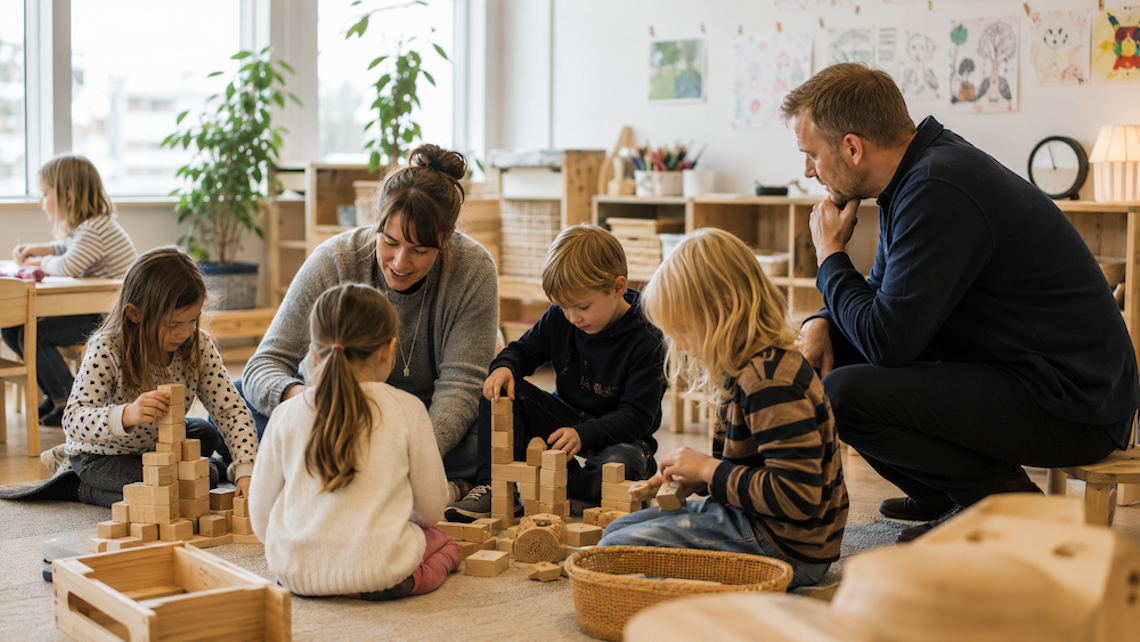
Imagine a child building with blocks while a teacher sits beside them. The teacher asks how many blocks have been used. The child counts accurately, so the teacher changes the question slightly and extends the challenge. Another child cannot count the blocks using one-to-one correspondence, so the teacher models the process, perhaps counts alongside them and then gives them another small group of blocks to try independently.
For the children, very little has changed. They are still building. For the teacher, however, a considerable amount of professional work has taken place. The teacher has noticed what a child can do, tested the edge of that understanding, provided support and made a judgement about whether to continue or return to the learning later.
This is one of the qualities I learned to look for when I moved into leadership. A teacher can have a laser-like focus on learning while the child experiences play.
Sometimes that focus becomes obvious simply by watching the interaction. At other times, one question can reveal a great deal: What learning are you focused on in this activity? The answer can open a useful professional conversation about what the teacher is noticing, why they have chosen to intervene and what they think the child may need next.
This matters because formality and rigor are not the same thing. A classroom in which children are building, talking, drawing and playing may contain highly deliberate teaching that is easy to underestimate if we do not understand the professional thinking beneath it.
Leaders do not need to become early-years teachers themselves. They do need to learn enough to recognise that professional thinking and to discuss it meaningfully with the teachers who understand it best.
Protecting varied learning experiences does not remove the professional responsibility to know how children are progressing.
In my own classroom, much of the evidence came from what children said, did and demonstrated. I kept checklists and notes and collected some work samples. Skills were often understood as progressions rather than simple yes-or-no judgements, which helped me see what a child could already do and what might reasonably come next.
The expected learning for the year provided an important reference point. Children capable of going further should of course be encouraged to do so, but higher achievement by some children cannot disguise the fact that another child has not yet secured an important foundation.
The curriculum expectation therefore matters as an entitlement, not as a ceiling.
Evidence did not always require a formal assessment. If I had not yet seen a child write their name, I might simply ask them to put it on the back of a picture. At other times, a more deliberate activity might be necessary. Observation, conversation and work samples together often provided a stronger picture than any one source alone.
The discipline was in making sure children did not disappear from view professionally. I needed to know what I had seen, what I had not yet seen and where further attention was required.
Varied learning experiences do not mean vague knowledge of progress.
For leaders, the useful question may therefore be less, Has every child completed the same assessment? and more, Do we know where every child is in their learning, and what are we doing with what we know?
There are things children are expected to learn during their first year of school. Teachers need clarity about those expectations, an understanding of progression and enough evidence to make responsible professional judgements about what children know and what they may need next.
Much of this professional precision already exists within strong F-klass practice. The opportunity created by the reform is to make it increasingly visible, shared and connected to the progression that follows.
What I would be cautious about is assuming that greater precision in adult professional work requires greater formality in children’s experience of school. Some learning will emerge through play, talk, movement and interaction. Some will require direct modelling or carefully structured practice. Sometimes the teacher will intervene immediately. Sometimes the better professional decision is to make a note and create another opportunity tomorrow.
The important thing is that the learning is not left to chance.
As a leader, I was particularly interested in whether children were mastering the foundations they needed for the next stage of schooling. Children who were capable of going further should be challenged, but the progress of the highest-achieving children could not compensate for others leaving without the learning they needed next.
That distinction feels particularly important as we think about the new årskurs 1. Greater clarity should not mean pushing every child further simply because greater formality has entered the structure of schooling. It should help us become increasingly precise about what every child is entitled to learn and increasingly responsive when that learning is not yet secure.
The professional work can become more deliberate without the child’s experience becoming unnecessarily more formal.
This final question brings the others back to leadership.
I was fortunate to have taught children of this age before I became a leader, but previous classroom experience is not the only way leaders can develop an understanding of high-quality early learning. One of the greatest sources of learning is already available within our schools: the expertise of the teachers doing this work now.
Leaders can spend time in classrooms. They can sit beside children rather than only walking through. They can watch skilled teachers closely and ask what they are noticing. They can examine progression and evidence with teachers. They can participate in professional learning rather than simply arranging for others to attend it.
That was how I continued learning when my own role changed. As a school leader, I spent time in classrooms and professional conversations. Later, as an avdelningschef, I attended professional learning, visited classrooms and talked with teachers about what they were seeing and doing.
I did not enter those conversations assuming that my interpretation was always correct. Sometimes I saw something that did not match my understanding and asked about it. Sometimes the explanation confirmed my concern. On other occasions, the teacher helped me see something I had missed.
That is where some of the most useful leadership learning occurs.
Leaders need enough knowledge to ask a worthwhile question, enough curiosity to listen carefully to the answer and enough humility to allow their own understanding to change.
This matters because leaders influence what gets protected. They influence time, staffing, professional learning, expectations and the conversations through which quality develops. If the structures surrounding early-years learning are changing, leaders need to understand the practices and conditions that should travel into the new structure with them.
It is difficult to protect quality we do not yet know how to recognise.
Much of the expertise needed for 2028 already exists in förskoleklass. That is an important starting point. The task is not to begin again or to assume that a new organisational structure requires us to discard what has already been learned about how six-year-olds learn well.
But the reform also creates a learning agenda for leadership.
By 2028, school leaders do not need to have become the early-years experts in their schools. There will almost certainly be teachers around them with deeper and more current specialist expertise. Leaders should, however, know enough to enter the conversation.
Can I discuss how six-year-olds learn and become ready to learn? Can I recognise high-quality learning when it does not look formal? Do I understand how teachers can know whether every child is progressing without turning every learning experience into an assessment event? Can I distinguish between greater professional precision and unnecessary formalisation? And do I understand enough to recognise, support and protect the quality that already exists while helping my school develop what the reform requires next?
I would not expect every leader to answer those questions in exactly the same way. But before 2028, I think they are questions we should be able to discuss well.
You do not need to begin as the expert. But you cannot stand outside the learning.
Read also: More Visible Learning – Not More Formal Schooling